Porcelain Pool: The Real Exam Lives in the Water
For a pool tile, the first test is not in the factory — it is in the pool itself. Will the color drift over years? Will the surface dull together with the lime film? Will the pure chlorine coming out of a salt cell eat away the joints? The answer lies in the body technology of the tile. Poolarch’s Serapool-sourced fullbody porcelain series are designed to distribute the chemical load across the entire body, creating a structural buffer against surface damage.
Effect of a Salt System on the Surface
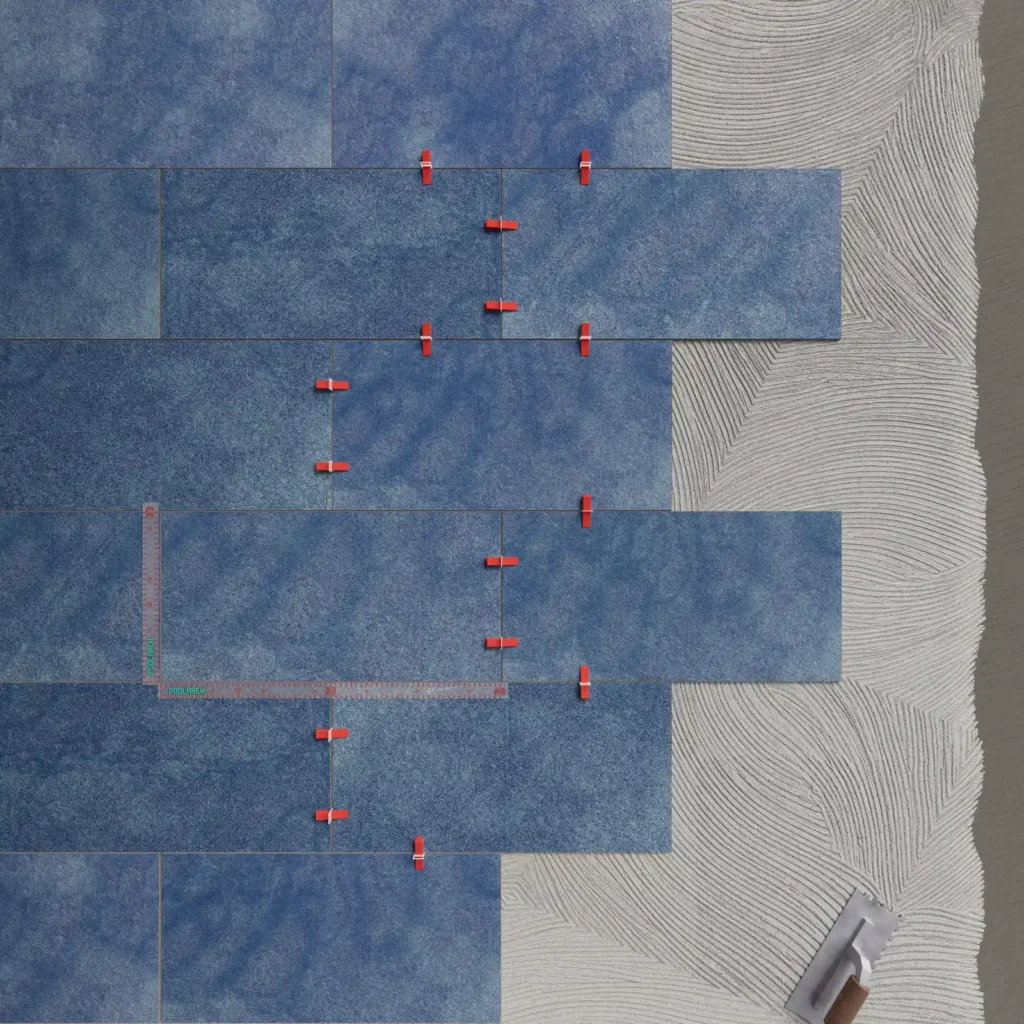
Salt chlorination dissolves around 3,000–4,000 ppm sodium chloride into the water. Lower than sea water, yet aggressive under continuous contact. When the chlorinator hydrolyzes the salt, high-concentration hypochlorite is released momentarily at the cell mouth — the toughest zone for the tile. A standard glazed tile behaves chemically separately from its clay body beneath; over time, microcracks widen. In fullbody porcelain the surface and the body share the same sintered porcelain composition, so the chemical load is distributed across the body. Relax Blue Pool Tile is the classic long-term cobalt option for salt-water builds.
Behavior Under Shock Chlorination
Traditional chlorinated pools occasionally see shock doses above 10 ppm to control algae and bacteria. These peaks fade tiles built on organic colorants. Fullbody porcelain colors come from inorganic pigments and minerals sintered into the body, so chlorine peaks do not move the color. Pastel tones are the most fade-sensitive palette and therefore the most telling proof point for body technology; in the Serapool fullbody family, pastels stay where they were on day one.
pH Swings and Lime Risk
Pool pH is held between 7.2 and 7.6. Outside this window either lime deposition (high pH) or surface corrosion (low pH) begins. Porcelain is non-porous, so lime particles can physically rest on the surface but cannot enter it — a maintenance brush removes them easily. Mixed-texture surfaces hide minor scaling visually because the texture already reads as mineral movement on the surface.
Natural Stone Look with Chemical Safety
Some owners want a natural-stone tone in the water; real natural stone cannot survive chlorine and salt. Porcelain is the only carrier that delivers the visual while preserving chemical safety. The Relax basalt, terrazzo and pebble surfaces translate stone aesthetics into porcelain chemistry. A clean white pebble appearance is another option in the same family, with the same fullbody resistance.
Green Tones Against Chlorine
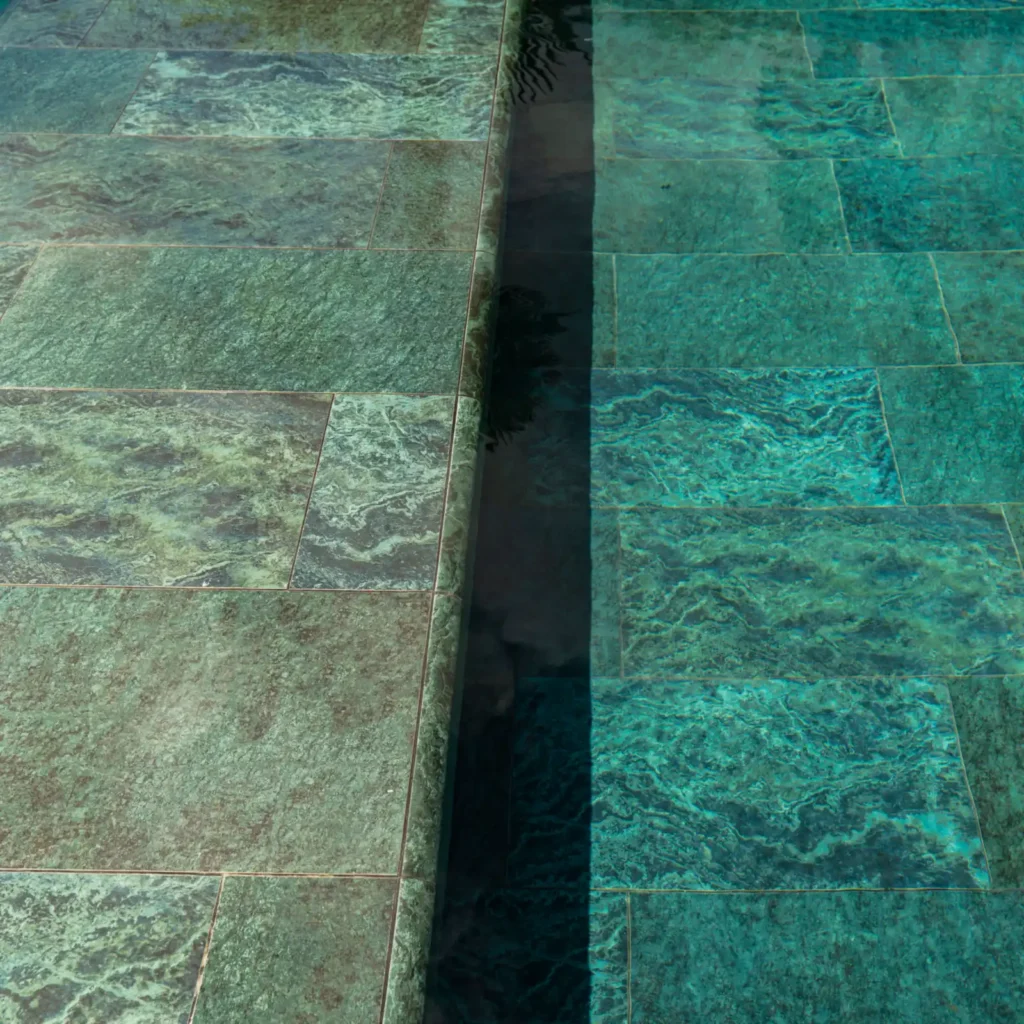
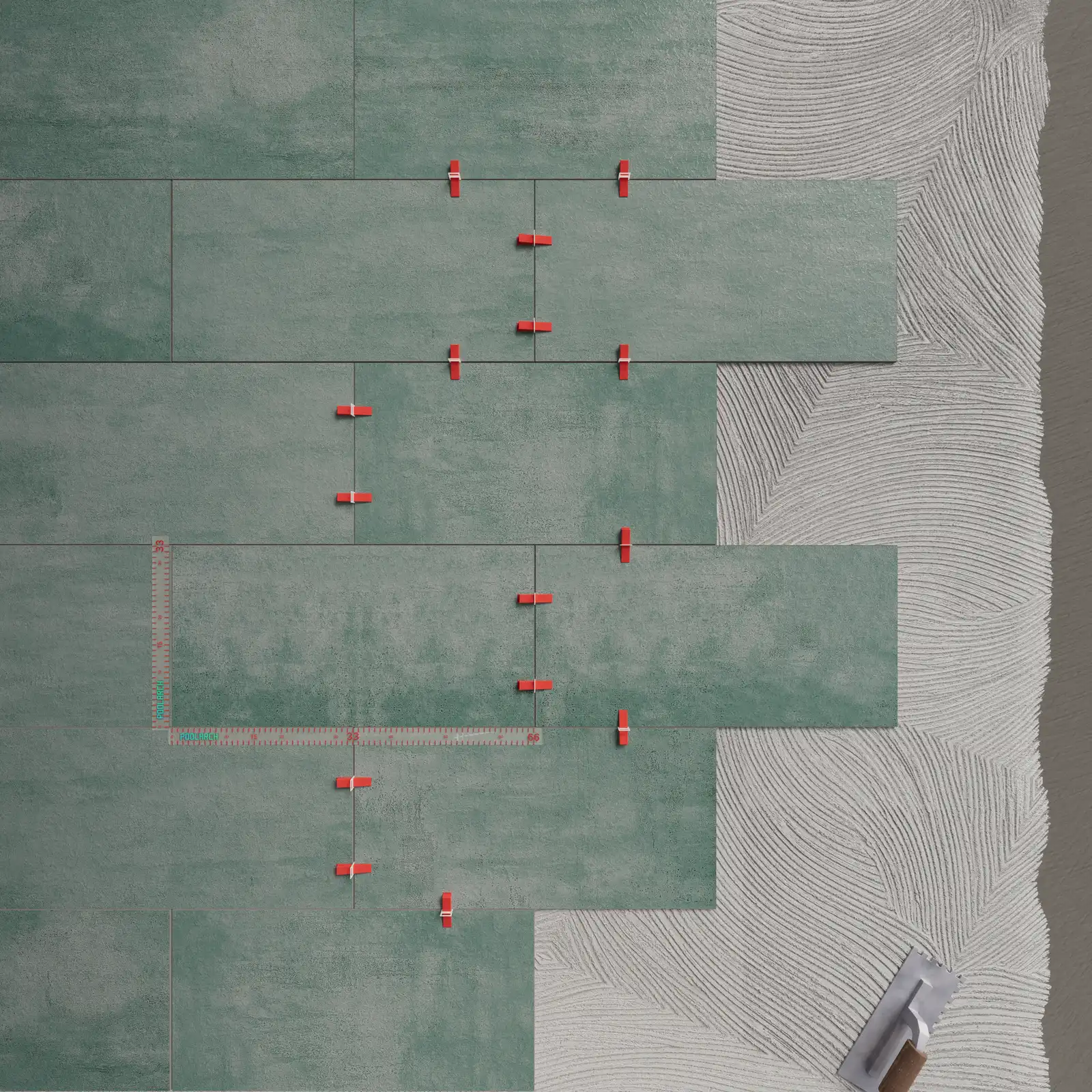
Green is the palette that suffered most on legacy tiles using organic pigments; a chlorine shock can turn green into yellowish gray within hours. Serapool fullbody greens are built on inorganic chromium-green and ceramic-oxide pigments, so chlorine simply stops time. Olive, oasis and seaside greens are designed to keep their day-one tone even under year-round chlorinated contact.
Chemical Resistance in Dark Tones
Dark colors raise surface temperature under sun, which accelerates chemical reactions. Body-surface homogeneity becomes more critical for anthracite and black. In the Serapool fullbody black, even theoretical micro-wear leaves the color in place because the body underneath shares the same color map as the surface.
Joint Line: The Hidden Weak Link
No matter how chemically resistant the porcelain itself is, the joint filler is the “weak link” of pool tiling. Standard cement-based grout softens over time under chlorine and salt. Poolarch therefore recommends high-polymer content, epoxy-modified or fully epoxy-reactive grout for in-pool applications. Correct grout selection can double the service life of the finest porcelain finish; incorrect grout leads to first-year complaints about the joint, not the tile body.
Maintenance Routine: Chemistry and Surface Live Together
Weekly pH check, monthly alkalinity and calcium hardness measurement, and seasonal salt-level control are as critical to the lifespan of the porcelain finish as the porcelain itself. Soft brushes, pH-neutral cleaners and, when needed, acid-free lime removers are ideal. Abrasive wire brushes and strong acids cause no harm to porcelain but destroy joints.
Detailed View
Poolarch leverages the Serapool R&D team’s salt and chlorine test protocols to recommend project-specific color and texture combinations. Serapool runs fullbody porcelain pool series through internal chemical protocols in addition to ISO standards; chlorine, bromine, salt, ozone and UV combination testing is the closest simulation to real-site behavior. For international projects, technical documentation and test reports are coordinated directly through Serapool — including dedicated reports for coastal venues exposed to salt water and salt air.
The Right Porcelain, the Water’s Quietest Ally
Pool water quality is delivered not only by filtration but also by the surface that will sit in contact with the water for years. A non-porous, inorganically pigmented porcelain that carries its color through the body speaks the same language as chlorine and salt — and stays quiet. The color stays in place, the surface keeps its gloss, maintenance becomes easier.
Pool Tile Prices
Let’s match the right fullbody porcelain to your salt water or traditional chlorine pool together. At Poolarch we offer transparent, project-scaled m² pricing for pool ceramic prices, pool tile prices and pool porcelain prices. To learn the exact m² price for your color, area, joint preference and accessory mix, reach out directly.
To receive a quotation within 24 hours, share your pool’s dimensions, the disinfection system in use (chlorine / salt / bromine / ozone) and your color preference via WhatsApp. Our technical team responds with a series recommendation tuned to your water chemistry and a consolidated quote including matching grout selection. Get a quick quote on WhatsApp.